Tuesday, July 05, 2005

The accompishments of Ape-man......or some humans who were a few evolutionary steps closer to him.


Some examples of the accomplishments of our primitive ancestors are the foundations of what would later become the temple mounts of various civilizations. These foundations often seem to be built with rather large stone blocks.

The most famous and important in modern politics is the Temple Mount in Jerusalem. Another example is a different foundation that later civilizations built their temples on:

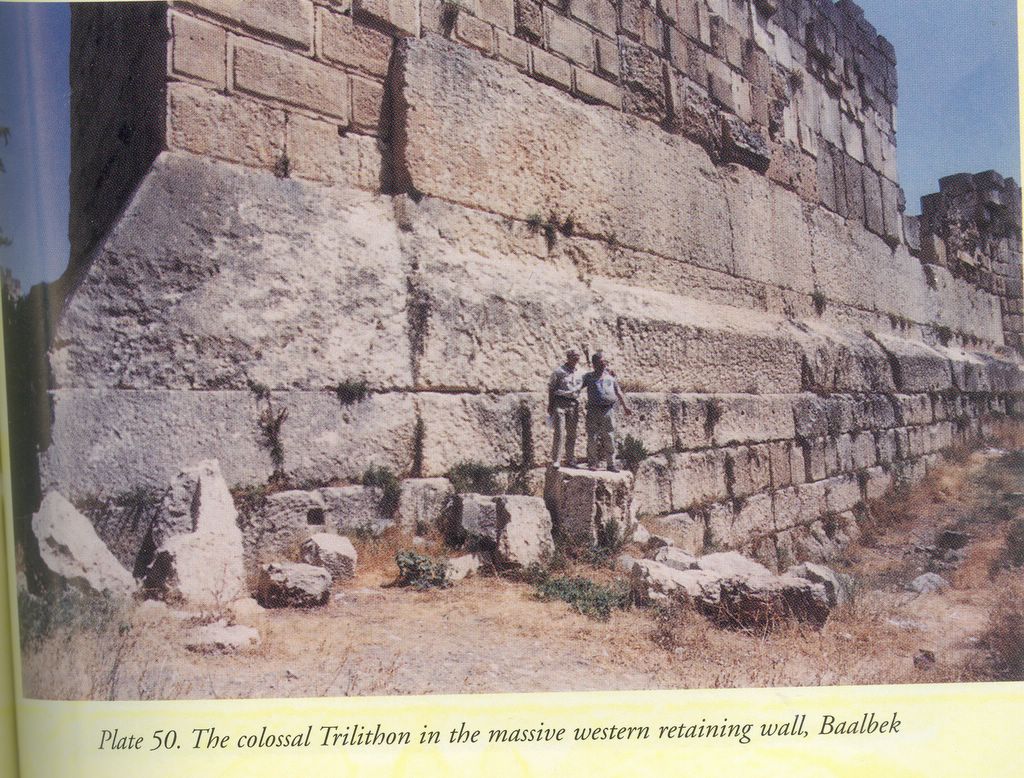
...it was time to start our own investigation. It led, first and foremost, out through the Jupiter temple all the way back and around the ruins, to the western retaining wall with its immense stone blocks, including the famed Trilithon.


The stone blocks that make up the Trilithon weigh more than 1,100 tons each, and they do not lie on the ground itself, but are placed higher, upon other immense, though smaller, stone blocks, cut to have a slanting face, that weigh “only” 500 tons each. (By comparison, the stone blocks in the Giza pyramid average only 2.5 tons.)

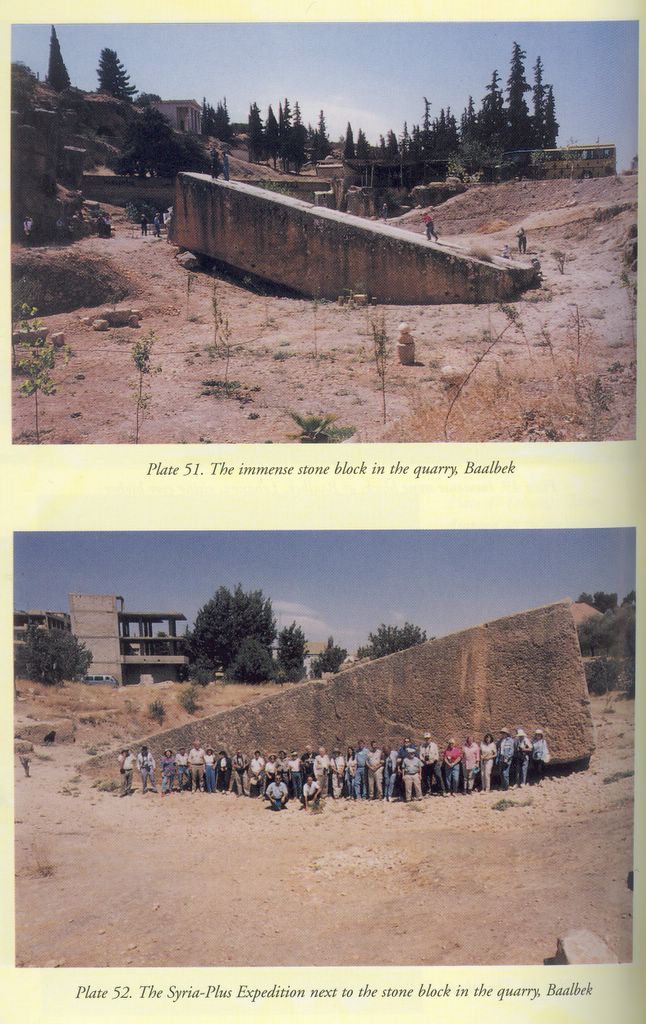
There is even now no man-made machine that can lift such weights. Yet in antiquity someone—the “giants,” according to local lore—not only lifted and placed such colossal stone blocks, but also carried them from their quarry located several miles away. This is an indisputable fact, because the quarry has been located and in it one of those colossal stone blocks, whose quarrying had not been completed, still lies partly attached to the native rock. Its immensity is illustrated by the many photographs we took there; its size exceeds that of the Trilithon blocks.


.... Everywhere the original stone blocks were immense; where later additions were made, the stone blocks are much smaller and look pitiful by comparison.

Whatever once stood upon the immense platform, other than in its cut-out northwestern part, one can only speculate. It is clear, however, that whoever planned, constructed, quarried, and transported the colossal stone blocks and then placed them one on top of another had a specific purpose in mind. Whatever went on there in the ancient past seems to have required this massive structure that rose up and up by massive stages.
(The Earth Chronicles Expeditions: Journeys to the Mythical Past
By Zecharia Sitchin :173-174)


That is the mythical past and speculation about mythologies and archaeology ought to be and are noted by scholars as fraught with uncertainty. That should not hold anyone back from studying such issues. Uncertainty is what tends to keep the scribbling scribes scribbling and the sages of the ages wondering and pondering.

In contrast, Darwinists often try to merge the mythological narratives of Naturalism that they sometimes write in with basic empirical observations or "scientific facts" like the earth being round. It seems that they want people to assume that their mythological narratives have reached the same epistemic level as basic empirical observations. Yet making that sort of associative argument and seeking to conflate Darwinism with basic empirical observations may indicate that the person knows little about extending Darwinian principles far, far into the past while at the same time making them elastic beyond current empirical observations. That type of argument of association made by Darwinists: "It's a fact that all of Life came about by natural selection acting on random mutations...as certain as gravity!" may also illustrate a failure to admit to the limitations of science in general, which can become the foundation of scientism and so the beginning of a path to proto-Nazism if history is any measure.

On science and origins:
How, then, should the scientist “approach origin questions”? With due modesty, I would say, born of the sobering recognition that his methods provide access only to a certain “outer shell” of things. There is of course more than enough work to do for the scientists within his own proper domain; and it could also be said that, to him who has “eyes to see”, that domain, bounded though it be, points beyond itself—even to “the invisible things of God”. At the very least, however, scientist should be aware of the distinction between primary and secondary origins and wary of forcing the former into the mold of the latter as the Darwinists have done. One should remember that science turns forthwith into pseudo-science and superstition the moment it oversteps its own proper bounds.
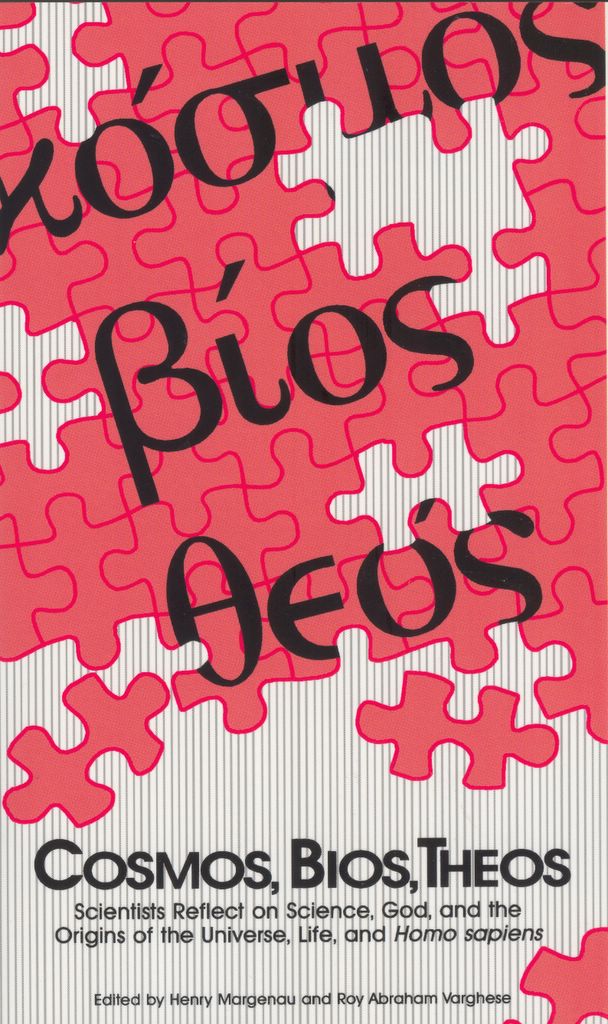
(Cosmsos, Bios, Theos: Scientists Reflect on Science, God, and the Origins of the Universe, Life and Homo sapiens
Edited by Henry Morgenau and Roy Varghese
Astronomers, Mathematicians and Physicists: Wolfgang Smith :116-117

I'm back.

Sheesh...the summer isn't that great a time for blogging. I went windsurfing over the Fourth of July weekend, read three interesting books, went out with my parents boating, out to dinner, etc.

I will probably make a few posts on the books I read. They were interesting. Just thought I'd leave a note that the blog isn't dead although it will be one day, just like me.

Thursday, June 30, 2005

Shhh....

It's fox-bee and camel-fly. They're a little like frog-bird and flower-snail.


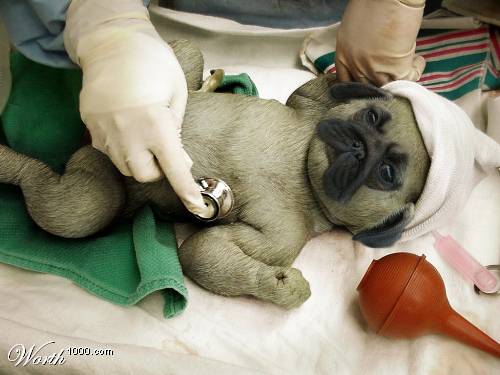
It seems that you never can tell what Nature may select by her natural selections because like the evolutionists say, all natural categories to be found in Life can be merged back to their common ancestor in a primordial pool. There's camel-fly, at rest on a plant.

I bet you can't tell who the common ancestor of this little fellow is.


"Don't look at me." says dogman....


Why it doesn't happen:

...specially shaped protein on the egg. No foreigners are allowed; a wrong species’ sperm would waste an egg. Only if the match is proper can the sperm force its way in, and fertilization occur. A new potential life is under way. Entrance of the sperm stimulates calcium ion channels in the egg’s wall to open. This immediately closes the egg’s membrane to all other invaders. One is company. Two’s a crowd, genetically speaking. The closure is first induced by a change in the electrical charge across the membrane, and then by a release of a chemical hardener that cross-links the gelatinous outer membrane coating.

The sperm is now within the egg, but it is kept at bay. The egg still has a full set of chromosomes, twenty-three pairs. Half must be discarded. At this stage the egg undergoes meiotic division, division without chromosome replication. Though the egg’s chromosomes are divided equally between the two new cells, as before, almost all the cytoplasm is concentrated in one daughter cell, that which contains the sperm’s nucleus. This done, the sperm and egg each duplicate their respective twenty-three chromatids, motor proteins move the two nuclei together, the nuclear membranes open, and the chromatids mingle, each finding and pairing with its corresponding partner. Spindle fibers and motor proteins then pull one member of each pair to opposite poles, two nuclear membranes form, and mitotic cellular division occurs. Another bio-ballet, a coordinated dance of molecules within the body, has passed. A few days and several further mitotic divisions will go by before this new bit of life reaches the uterus.

At this point, one has to bend over backward to accept that all of these necessary and interwoven steps have evolved randomly. There are only two forms of reproduction, mitosis and meiosis. There are no intermediate forms visible in nature. Yet somehow, according to evolutionists, a batch of lucky mutations allowed meiosis to blossom on the tree of life.

In human reproduction, meiosis gives way to mitosis, but with an amazing twist to the mitotic principle of daughter cells being replicas of the parent. As the cells divide, some of the daughters discover or interpret how and where to become the cells of a heart, and some a nose or toe. How this miracle of structuring occurs remains a speculative mystery. The knowledgeable differentiation among the newly forming cells appears in principle to be orchestrated by concentration gradients of specific molecules within the cluster of cells, but the wonder of it remains. Who or what supplied the scheme? Wisdom is encoded in the very stuff on which it must act, the blueprint and the builder all in one.
(The Hidden Face of God: Science
Reveals the Ultimate Truth
By Gerald L. Schroeder :77-78)

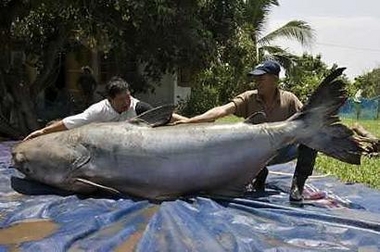
Fisherman catch and eat fish that scientists were trying to study.


WASHINGTON (Reuters) - Fishermen in northern Thailand have caught the biggest catfish on record -- a 646-pound (293-kg) giant the size of a grizzly bear -- and eaten it, the WWF and the National Geographic Society said on Wednesday. (Continue reading)

The New Thought Police

Modern "liberalism," an example from Europe:

'Brainstorming', the buzzword used by executives to generate ideas among their staff, has been deemed politically incorrect by civil servants because it is thought to be offensive to people with brain disorders.

Instead staff at the Department of Enterprise, Trade and Investment (DETI) in Belfast will use the term 'thought-showers' when they get together to think creatively. A spokeswoman said: 'The DETI does not use the term brainstorming on its training courses on the grounds that it may be deemed pejorative.'

Sources inside the department said there was concern that the term would cause offence to people with epilepsy as well those with brain tumours or brain injuries.

But the Campaign for Plain English complained that the decision had 'reached the point of real ridicule'.

'You do sometimes wonder if some people haven't got anything better to do with their time,' said spokesman John Wild.

(Now brainstorms are off the agenda
By Henry McDonald, Ireland editor
Sunday June 26, 2005
The Observer )

See:
(The New Thought Police: Inside the Left's Assault on Free Speech and Free Minds, by Tammy Bruce)