Sunday, January 29, 2006

That's surprising.

As I recall the novelist Kurt Vonnegut is one of those fellows who points to the parasites, the viruses, the venereal diseases and so on, throws up his hands and wonders why it all exists if God is good. That's the way he engages in natural theology and blames Good for evil, which matches the Darwinian way. As the Devil might say of Good, "If God is good then how do I exist? Now throw yourself off this cliff as I have, since God is good he will still let you exist just as I do! I do exist, don't I?"

But anyway, on the other hand Vonnegut apparently also says:
...look, my body and your body are miracles of design. Scientists are pretending they have the answer as how we got this way when natural selection couldn’t possibly have produced such machines.

INSKEEP: Does that mean you would favor teaching intelligent design in the classroom?

Mr. VONNEGUT: Look, if it’s what we’re thinking about all the time; if I were a physics teacher or a science teacher, it’d be on my mind all the time as to how the hell we really got this way. It’s a perfectly natural human thought and, okay, if you go into the science class you can’t think this? Well, alright, as soon as you leave you can start thinking about it again without giving aid and comfort to the lunatic fringe of the Christian religion.
(Interview on NPR, cf. ID the Future)

Well, it's like this. If the issue of origins is taught in science class and anything but the Darwinian creation myth is taught then modern medicine will cease because it came about based on the survival of the fittest, while Creationist engineers* will stop designing technology because they rely on natural chance instead of design, which is unnatural, and so on. So although the evidence goes overwhelmingly against Darwinism, leaving Darwinists pointing to people born with elongated spines or pointing to their own noses and saying, "Would you just look at these things...why God, why?!" it is still what must be taught so that medicine and technology do not just crumble away. For isn't it obvious that they rely on the Darwinian creation myth?

Anyway, Vonnegut also said, "Something perfectly wonderful is going on. I do not doubt it..." Interesting, I agree. But given all the war, the starvation, the rape, etc., there is clearly something terrible going on too. That can be known by anyone who has any sense of good and evil left in them.

Yet it is good, there is much that is good. I think that most people just go with whatever mood they are in at any given time though. If they are in love, then it is all good, so good. But if someone just cut them off in traffic then God should just end it all now because it's all just so damned evil, especially those damned drivers.

We're fickle like that, with no real perspective to judge either.

*Even the mental retards have noticed: "...the Salem Hypothesis states that creationists with formal educations are more likely to be engineers than they are to be other kinds of scientists. This hypothesis is supported primarily by anecdotal evidence: a good number of creationists who post to talk.origins claim to be engineers, and creationist organizations seem to be disproportionately populated by engineers. Why engineers would be more prone to creationism than other scientists is a good question." (Talk.origins) Well...is it so hard to figure out why that would be so given that they work with design problems in the real world every day instead of engaging in natural theology of a sort based on prissy Christianity, e.g.: "Why would God let excretory organs exist next to reproductive organs? So it is settled then, Nature selected all the organization in all the millions of organisms that exist by uh...things living and dying."

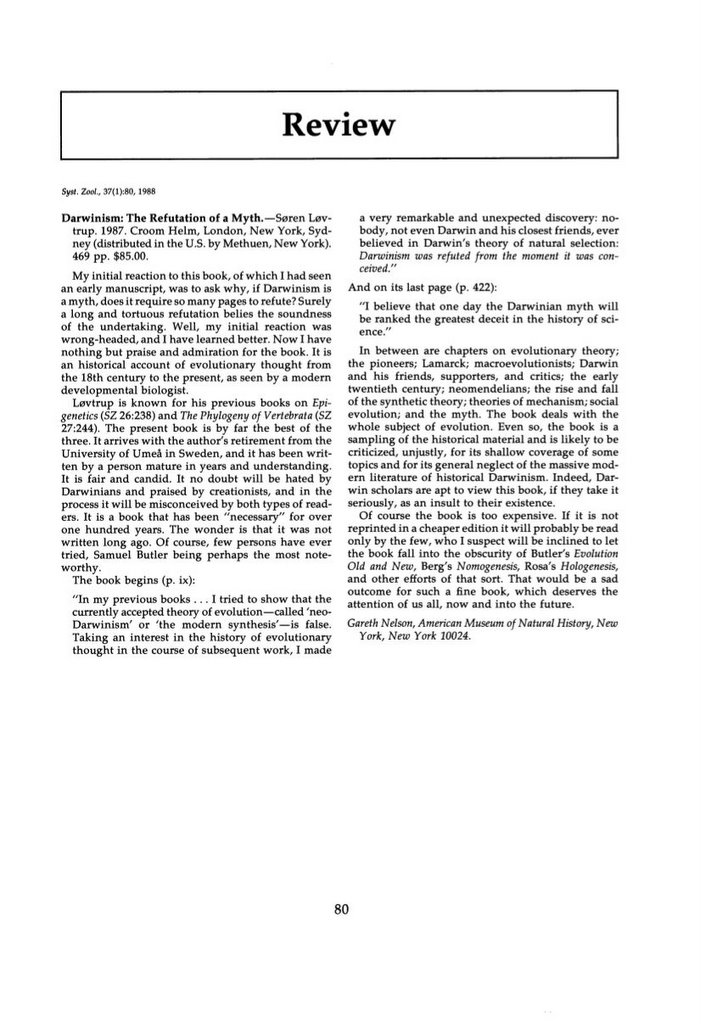
Darwinism: The Refutation of a Myth.—Søren


Another scholar takes the Darwinian mind at its own words:
The book begins (p. ix):
“In my previous books... I tried to show that the currently accepted theory of evolution—called ‘neoDarwinism’ or ‘the modern synthesis’—is false. Taking an interest in the history of evolutionary thought in the course of subsequent work, I made a very remarkable and unexpected discovery: nobody, not even Darwin and his closest friends, ever believed in Darwin’s theory of natural selection: Darwinism was refuted from the moment it was conceived.”
And on its last page (p. 422):
“I believe that one day the Darwinian myth will be ranked the greatest deceit in the history of science.”
(Darwinism: The Refutation of a Myth
Reviewed by Gareth Neslson
Systematic Zoology, Vol. 37, No. 1 (Mar., 1988) :80)

It was Richard Dawkins who noted: "It is almost as if the human brain were specifically designed to misunderstand Darwinism, and to find it hard to believe..."

Isn't it ironic.

Note that all a scholar has to disagree with to come into disagreement with Darwinism is the assertion that historical claims or mythological narratives of Naturalism about random variation and natural selection explain the organization of all organisms. I.e. the Darwinian assertion is that organisms learning and designing is an illusion. Note how it is not apparent how the Darwinian mind designed its statement to contain any meaning or purpose, yet it imagines it is so.

The anti-Darwinian notion that they have "emergent properties" that are vital to their existence or which shape their evolution is also said to be false, nor do organisms make any choices with respect to how they will organize. Instead the explanation for their whole being is their evolutionary history, which Bios/Life has no role in because all "selection" comes from an inanimate environment given natural selection. Isn't it ironic that Darwinism is anti-biological and cannot explain the origin of Life, nor much of the organization typical to it either. It seems that the most unnatural thing to the Darwinian mind is Life itself, naturally enough. Given its failure to study Life the claims of the Darwinian mind are more historical than biological, e.g.
The viewpoint of Coyne et al. (1988) is one in which past events are argued to explain, in a causal sense, the world around us. Such explanations cannot be verified or tested, and the only biological observations they require are that variation and differential reproduction occur. [I.e., "Things change or somethin'."] This is not a caricature, as a reading of Coyne et al. will verify. [Those with the urge to merge will claim that all definition is false, including their own. I.e., "Strawman, I say!" And if you pin down their mind with their own texts and language then they will snivel about "quote mining," "semantics" or "rhetoric" as definition brings an end to their merging.] In keeping with this general viewpoint, proponents claim that species are explained with reference to history. Important characters are hence “mechanisms” that have established and maintained the separation between diverged lineages of an ancestral population. According to Coyne et al., even the adaptive purpose of the changes that resulted in these mechanisms is irrelevant.
We would ask where biology enters into this schema. The answer is that it does not. Rather, biology is interpreted in terms of a range of historical processes, including selection of variation over time. This could, with equal relevance, be used to understand any nonbiological phenomenon such as the development of the automobile, agricultural methods, culture, or men’s suits (Lewontin, 1976).
[...]
Let us outline the terms of the disagreement so as to avoid any possible confusion. Within contemporary biology it is commonly argued (e.g., Mayr, 1988) that, in order to maintain the distinctness of species, their integrity must be protected. This protection will have evolved as a result of a history of natural selection on individual genes and characters that have the “function” or “effect” (sensu Williams, 1966) of isolating one species from another. The isolation concept of species is, therefore, not separable from such a historical approach to biology. According to this viewpoint, species are only understandable in terms of history, as Mayr (1988) so correctly recognized.
In contrast, our view is that the biological-process of mate recognition results in species self-definition, and mate recognition represents the most appropriate basis for the delimitation of particular species (Michaux et al., 1990). Rather than regarding mate recognition as a set of independent traits that isolate species, we view it as a highly integrated communication system. As such, it is not amenable to selectionist and/or reductionist analyses. In a more general sense we suggest that biology should have primacy over historical scenarios (Lambert et al., 1989). That is, although we acknowledge that all attempts to investigate the world are colored by theoretical perspectives, we strongly believe that explanations should derive from knowledge of demonstrable biological phenomena rather than historical suppositions.
(Points of View
Species and Neo-Darwinism
By C. S. White; B. Michaux; D. M. Lambert
Systematic Zoology, Vol. 39, No. 4. (Dec., 1990), :400-401)

Saturday, January 28, 2006

The Darwinian mind...or lack thereof...

I was going round about with some people apparently easily overwhelmed and taken in by the charlatans of talk.origins here. I think I will use some of their text as material here later. I'm most impressed by the, "This looks a little like that or somethin'." type of argument, as well as the notion of humans with tails being used as part of the evidence that so easily overwhelms half-wits. For that matter, Darwin used his own nose as material evidence...but I'll get to such things later. The Darwinian mind is good material to grow the ideas of Life in, given that the excretions of the Darwinian brain are the excrement that the mind smothers itself in. So it can be used for good fertilizer for the conceiving of the conceptual, if the perceptual is cultivated by language.

Wednesday, January 25, 2006

Cause and Effect


The laws of physics, I understand, decree that when one billiards ball (A) sets another billiards ball (B) in motion, the momentum lost by A exactly equals the momentum gained by B. This is a Law. That is, this is the pattern to which the movement of the two billiards balls must conform. Provided, of course that something sets ball A in motion. And here comes the snag. The law won’t set it in motion. It is usually a man with a cue who does that. But a man with a cue would send us back to free-will, so let us assume that it was lying on a table in a liner and that what set it in motion was a lurch of the ship. In that case it was not the law which produced the movement; it was a wave. And that wave, though it certainly moved according to the laws of physics, was not moved by them. It was shoved by other waves, and by winds, and so forth. And however far you traced the story back you would never find the laws of Nature causing anything.

The dazzlingly obvious conclusion now arose, in my mind: in the whole history of the universe the laws of Nature have never produced a single event. They are the pattern to which every event must conform, provided only that it can be induced to happen.
--C.S. Lewis on the Laws of Nature (The Quotable Lewis :457-458)

[Edit: There are various philosophical problems with what Lewis said, yet that type of thinking has proven to be as good a start as any.]

Art History

Tuesday, January 24, 2006

The Scandal of the Evangelical Mind

It's probably why comments like this: ""We've been attacked by the intelligent, educated segment of the culture," he said, adding that the school board's declaration is just a first step." happen. (From Pharyngula)

PZ Myers and writers like him conflate an American cultural tendency with evidence for the veracity of the Darwinian creation myth, thinking that if scientists or intellectuals tend to believe something then that is evidence that it is true. The Darwinian Herd is especially fond of this type of supposed evidence, in fact it sometimes seems that it is their only argument and the actual empirical evidence does not matter as long as there is a "scientific consensus" or everyone who is educated thinks that it is so. This neglects the fact that even the most educated segments of any culture have maintained incorrect beliefs. E.g. the belief of educated Chinese for some time that the earth was flat that can be proven from their texts, unlike the Darwinist and progressive myth that educated people in the West used to think that the earth was flat. It's a mistake to think that scientific consensus or "everyone knows" is evidence of any type. Evidence indicates that when people begin using that argument in lieu of pounding their opponents over the head with evidence then it is the time to question their claims and focus on the evidence.

But why would a pastor say such a thing and feel that he is ignorant and stupid as opposed to the educated and intelligent? There are a few reasons other than the fact that cold toads like Myers have been sucessful in abusing the State to set it against "religious" education so that people are forced by the State to spend billions of dollars on "secular education" while they are not allowed the choose to educate their children religiously. The main reason for such weakness seems to be the Scandal of the Evangelical Mind:
Institutional dimensions of the intellectual scandal do not exhaust the difficulties for evangelical higher education. A further problem is created by the generations-long failure of the evangelical community to nurture the life of the mind. That failure has created what William Hull, provost of Samford University; has called “the tragic imbalance which now exists according to which the dominant religion in America is almost destitute of intellectual firepower.” As Hull describes it, the desire to carry “the Christian dimension to the heart of the learning process” must advance realistically. College administrators and intellectuals in the churches must face the sober realities that Hull encountered when he sought to define such a goal at his own university:
Long experience in academic personnel recruitment convinces me that a sufficiently large pool of qualified candidates to staff [an] entire University faculty with Christian scholars . . . is just not out there. . . . Suffice it to say that the church has failed to define its intellectual responsibilities in compelling terms, to call out from among its own those gifted to discharge this neglected stewardship, and to provide such budding scholars with support for the kind of advanced training that will equip them to do credible work on so exacting a frontier. The very few who decide to make the integration of Christianity and scholarship a lifelong calling usually do so at their own initiative, with precious little encouragement either from the church or from the academy. Ironically, the handful who do express an early interest in the vocation of Christian scholar are usually shunted into seminary for graduate theological study, producing a surplus of those qualified to teach religion but a paucity of those trained to teach the other ninety-five percent of the academic disciplines as they relate to the Christian faith. . . . We must not deceive ourselves into supposing that there is a large guild of seasoned Christian scholars somewhere on which we can draw in staffing our University faculty.

[...]
Nowhere in the Western world is it possible to find an institution for graduate training — that is, for the training required to teach at evangelical institutions of higher learning — that exists for the primary purpose of promoting Christian scholarship defined in a Protestant, evangelical way. Thankfully, there are a few Roman Catholic and Jewish institutions where Catholic or Jewish understandings of God and the world receive careful attention, and evangelical scholars have sometimes made use of such institutions. But for most of the faculty members at most evangelical institutions of higher learning, to ask in the course of their most advanced training the deepest and highest questions about the relationship between God and the world would be irrelevant, or it would create prejudice against them. Yet, once called to evangelical institutions, part of the task of these same scholars is to guide students and publish research that asks precisely those questions.
In sum, the scandal of the evangelical mind arises from the specific institutional arrangements of evangelical higher learning in North America. Even if an evangelical were convinced that deep, probing study of the world should be undertaken as a specifically Christian task, it is by no means self-evident where that task could be pursued.
Finally, there is a theological dimension to the scandal of the evangelical mind. For an entire Christian community to neglect, generation after generation, serious attention to the mind, nature, society, the arts — all spheres created by God and sustained for his own glory — may be, in fact, sinful. Os Guinness has recently called attention to this dimension in a memorable passage worth quoting at length:
Evangelicals have been deeply sinful in being anti-intellectual ever since the 1820s and 1830s. For the longest time we didn’t pay the cultural price for that because we had the numbers, the social zeal, and the spiritual passion for the gospel. But today we are beginning to pay the cultural price. And you can see that most evangelicals simply don’t think. For example, there has been no serious evangelical public philosophy in this century. . . . It has always been a sin not to love the Lord our God with our minds as well as our hearts and souls. . . . We have excused this with a degree of pietism and pretend[ing] that this is something other than what it is — that is, sin. . . . Evangelicals need to repent of their refusal to think Christianly and to develop the mind of Christ.
The scandal of the evangelical mind is a scandal from whichever direction it is viewed. It is a scandal arising from the historical experience of an entire subculture. It is a scandal to which the shape of evangelical institutions have contributed. Most of all, it is a scandal because it scorns the good gifts of a loving God. The rest of this book is an effort to show why this scandal emerged as it did in North America and how it might be possible to minimize its pernicious effects.
(The Scandal of the Evangelical Mind
By Mark A. Noll :21-23)

I've noticed that too, some seem to keep things hermeneutically sealed, real tight like. Good biblical scholarship....and well, that's about it, as if there is nothing more to God and Life than text. On the other hand there are the charismatic types and well, wow...some of that clearly isn't even Christian in any form, let alone Christianity informed by text. In trying to deal with it once with people who I did not know were given to such things at first, the main criticism against my criticism seemed to match the pastor's above. I.e. it was a sin for me to use intelligence to go on the attack and so on. It's a curious pattern.