Monday, June 06, 2005

Artists and War


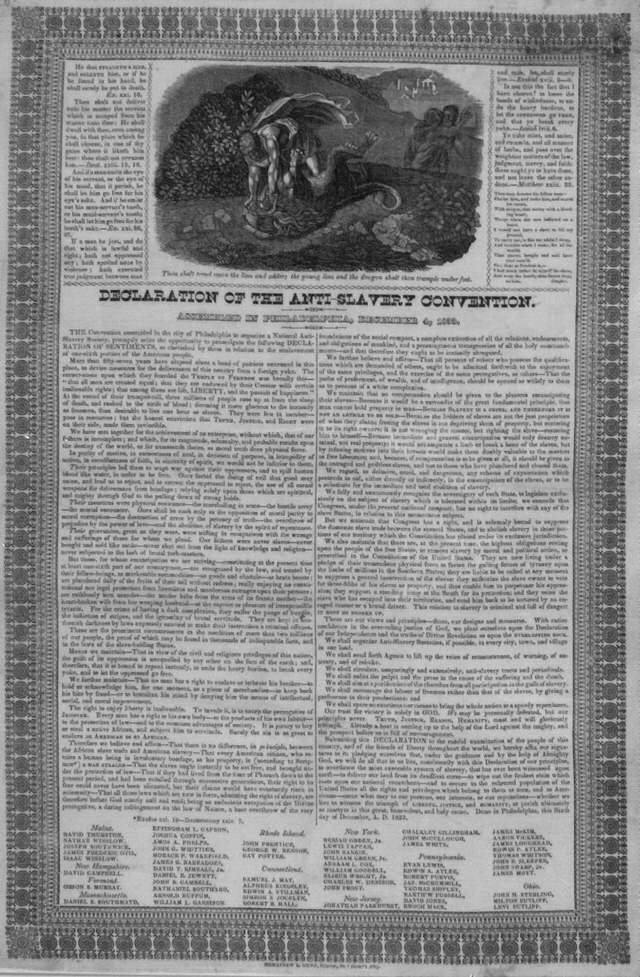
Notice how the abolitionists invoked the mental metaphor of spiritual war, I've noticed that this sort of artistic vision scares people who are being evil to this day.

Aboltionist art portrayed slavery as pure Evil:
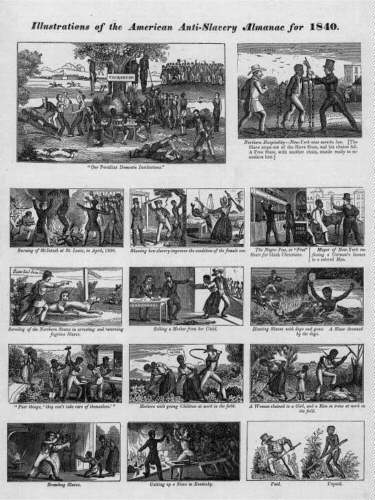

You might reply, "Portrayed? Why, everyone knows that slavery was evil..."

They think so now largely thanks to people like the abolitionists. But at the time the issue was blurred and people argued, "Well, I know some nice slave owners so how can they make such bad pictures! Why...I, uh, those pictures are just outrageous stereotype!" (There is an emotional and personal argument only focusing on subjectivism to shift away from focusing on an objective sense of Good and Evil.)

Or, "Slaves are better cared for by the slave owners that I know. Why do abolitionists have to be such zealots about it? We need to kick them out of the church because they're scaring away all the tolerant people." (There is the Big Meanie meme, some moral equivalency and shifting to murmuring about tolerance.)

I'm summarizing and updating the language some. Yet I can cite the newspapers in which people make arguments structured like this to demonstrate it. To this day people who pretty much know that they are in the wrong and so supporting evil still make various arguments with the same structures and shifts. It is important to note that back in that day there was tremendous pressure brought against the abolitionists.

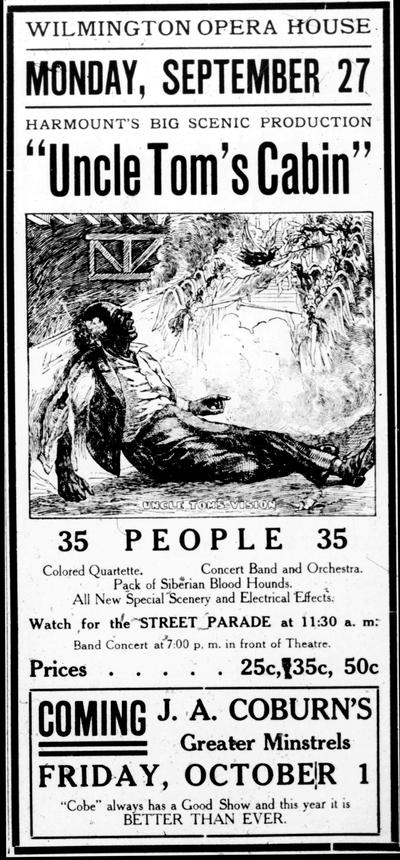
Back to the art, the best of which is a fusion of Good common senses and emotions, example:
In matters of art there is but one rule, to paint and to move. And where shall we find conditions more complete, types more vivid, situations more touching, more original, than in Uncle Tom?
--George Sand
______

A parable about honest Abe, a moderate politician who the abolitionists, zealots that they were, had to light the flame of righteousness under.

Abe was honest indeed but he felt like he was being smothered by crushing doubt and a dark despair. He was weakened and sometimes he could only focus on the union...union. The abolitionists were all about justice, principle and righteousness. So even a little lady had more jots to her story than honest Abe wanted to write. Like the other abolitionists she wrote some things about jots and the justice of things. She knew how to put some flesh on dry bones and the telling of stories is a powerful thing to do when they match the patterns of life and appeal to common senses.

So she and the abolitionists lit the flame of righteousness and the nation started to burn!

Now, one day honest Abe met her and said to her, "So this is the little lady who made this big war?"

But she saw the laughter behind his sad eyes and no accusation. He was thanking her. Some moderates need the flame of righteousness to be lit under their butts, after all. In the end, they know it too.
_______

History:
On June 5, 1851, Uncle Tom's Cabin; or, Life Among the Lowly began to appear in serial form in the Washington National Era, an abolitionist weekly. Harriet Beecher Stowe's anti-slavery story was published in forty installments over the next ten months. For her story Mrs. Stowe was paid $300.

Although the weekly had a limited circulation, its audience increased as reader after reader passed their copy along to another. In March 1852, a Boston publisher decided to issue Uncle Tom's Cabin as a book and it became an instant best seller. Three hundred thousand copies were sold the first year, and about 2,000,000 copies were sold worldwide by 1857. For one three month period Stowe reportedly received $10,000 in royalties. Across the nation people discussed the novel and hotly debated the most pressing socio-political issue dramatized in its narrative, slavery.

Because Uncle Tom's Cabin so polarized the abolitionist and anti-abolitionist debate, some claim it to be one of the causes of the Civil War. Indeed, when President Lincoln received its author, Harriet Beecher Stowe, at the White House in 1862, legend has it he exclaimed, "So this is the little lady who made this big war?
(cf. The Library of Congress)

Sunday, June 05, 2005

The crafting of memes...

Apparently the way that the leading minds of Gay© activism have crafted their memes to spread through the MTVeee generation has been picked up on.

Example:
...[Darwinists] divide the world into the moronic masses who reject Darwinism and its consequences, and the smart people (themselves) who believe it. Take Richard Dawkins and Daniel Dennett’s latest attempt to make atheism more alluring to the wider culture. They propose the word “bright” to serve the same role with respect to atheism as the word “gay” serves with respect to homosexuality. Dawkins writes:
Paul Geisert and Mynga Futrell, of Sacramento, California, have set out to coin a new word, a new “gay.” Like gay, it should be a noun hijacked from an adjective, with its original meaning changed but not too much. Like gay, it should be catchy. . . . Like gay, it should be positive, warm, cheerful, bright. Bright? Yes, bright. Bright is the word, the new noun. I am a bright. You are a bright. She is a bright. We are the brights. Isn’t it about time you came out as a bright? Is he a bright? I can’t imagine falling for a woman who was not a bright. The website www.celeb-atheists.com suggests numerous intellectuals and other famous people are brights. . . . A bright is a person whose world view is free of supernatural and mystical elements. The ethics and actions of a bright are based on a naturalistic world view. . . . You can sign on as a bright at www.the-brights.net.
Since an atheistic woridview is best nourished on Darwinism (it was Dawkins, after all, who said that Darwin made it possible to be an intellectually fulfilled atheist), it follows that “brights” are also Darwinists. Perhaps in the future we shall see articles and books about “Darwin’s Bright Idea.”
(Uncommon Dissent: Intellectuals Who
Find Darwinism Unconvincing
Introduction
Edited by William Dembski)


I chuckled and wondered if that was a joke. I suppose it is not. That's not really how the invention of an identity is done. Perhaps Dawkins needs someone to show him how to go about crafting an image for the sake of emotional manipulations. For instance, the leading minds of Gay© activism would tell him to be sure to change every nerd getting beat up in school into a form of emotional conditioning, for example: "If you don't teach what we say in schools then the Brights© will get beat up! You don't agree with us? Why do you hate all Bright People?" And so on. There is evidence that the Old Press will eat these sort of memes up. It is a way to set the moral vanity typical to journalists to work for the message. Then they'll repeat the story over and over, based on the scripts given them.

Note how Dawkin's form of identity politics comes off as almost a corny joke. Here is more of how it is done, note how emotional conditioning has to be interwoven throughout in contrast to the way Dawkin's rational analysis of what is going on undermines such manipulations:
In any campaign to win over the public, gays must be portrayed as victims in need of protection so that straights will be inclined by reflex to adopt the role of protector. If gays present themselves, instead, as a strong and arrogant tribe promoting a defiantly nonconformist lifestyle, they are more likely to be seen as a public menace that warrants resistance and oppression. For that reason, we must forego the temptation to strut our gay pride publicly to such an extent that we undermine our victim image. And we must walk the fine line between impressing straights with our great numbers, on the one hand, and igniting their hostile paranoia—’They’re all around us!’—on the other.
The purpose of victim imagery is to make straights feel very uncomfortable; that is, to jam with shame the self-righteous pride that would ordinarily accompany and reward their antigay belligerence, and to lay groundwork for the process of conversion by helping straights identify with gays and sympathize with their underdog status.To this end, an effective media campaign would make use of symbols and spokespersons that reduce the straight majority’s sense of threat and induce it to lower its guard. [....]
Persons featured in the media campaign should be wholesome and admirable by straight standards, and completely unexceptional in appearance; in a word, they should be indistinguishable from the straights we’d like to reach. In practical terms, this means that cocky mustachioed leathermen, drag queens, and bull dykes would not appear in gay commercials and other public presentations. Conventional young people, middle-aged women, and older folks of all races would be featured, not to mention the parents and straight friends of gays. One could also argue that lesbians should be featured more promi nently than gay men in the early stages of the media campaign. Straights generally have fewer and cloudier preconceptions about lesbians and may feel less hostile toward them. And as women (generally seen as less threatening and more vulnerable than men), lesbians may be more credible objects of sympathy.
It cannot go without saying, incidentally, that groups on the farthest margins of acceptability, such as NAMBLA, must play no part at all in such a campaign. Suspected child molesters will never look like victims. Now, two different messages about the Gay Victim are worth communicating. First, the public should be persuaded that gays are victims of circumstance, that they no more chose their sexual orientation than they did, say, their height, skin color, talents, or limitations. [....]
To suggest in public that homosexuality might be chosen [Oops...] is to open the can of worms labeled ‘moral choice and sin’ and give the religious Intransigents a stick to beat us with. Straights must be taught that it is as natural for some persons to be homosexual as it is for others to be heterosexual: wickedness and seduction have nothing to do with it. And since no choice is involved, gayness can be no more blame worthy than straightness.
(After the Ball: How America will conquer its fear & hatred of Gays in the 90's
By Marshall Kirk and Hunter Madsen :183-184)


The invention of a meme of interest to me:


How it scores:

"Incidentally, note that this ad and others in our portfolio use the term 'homophobia,' not 'homohatred.' While the later term might be more accurate, '-phobia' works better as rhetoric because it's less offensive to straights and suggests, in quasi-clinical terms, that anti-gay feelings stem exclusively from the bigot's own unhealthy psychological hangups and insecurities." (Ib. :221)

But how does that ad score as far as historical accuracy? Not well. For instance, if he was such a "homophobe" then why did he hang around with Gays© so much, to the point that it was rumored he must've been Gay© and so on? Suffice it to say that the point of crafting these memes for the MTVeee generation of the 1990s was not philosophical and historical accuracy. It is interesting to note that Kirk and Madsen begin with evolutionism and end with a cynical disregard for the truth. So their Hitler ad has an irony to it. Who waged a disinformation campaign based on emotional conditioning sans the truth in the past?

There is some truth mixed throughout what they say, i.e. real victimization, yet overall most of Gay© activism (of which this was a handbook) is a disinformation campaign that apparently comes to be misinformation in the memes of the MTVeee generation.

Saturday, June 04, 2005

UFOs and Aliens

Why do the UFO types always have to bring the Bible into things?

Example: The UFO prophet (Video is 4Mb, there are many accounts of this sort of UFO but not that many videos.)

I wrote a paragraph on it that I just deleted. Hmmm, it is actually a bit hard to give a natural explanation without invoking a government conspiracy and the like. He claims to be a prophet of Yahweh and that makes things a bit dicey. But I wonder why he seems to slip sometimes into claiming to be Yahweh or "prophet Yahweh," eh? How about this, you tell me what you think of him! I would write what I think but I don't want to taint any replies with my expert opinions. Just kidding, I've not read much about UFO things. It seems to be a good excercise in deconstruction and trying to find the truth in narratives. There are a limited number of stories there can be about a given phenomenon such as the one in the video and they can wind down based on logic and further empirical evidence.

On a different element of the UFO phenomena, a fictional story:
Once upon a time there were two UFOlogists and a fellow asked them how they became Christians. One of them replied, "Well, it was the whole anal probing thing that the 'space brothers' seemed to be into." The other noted, "Yeah, I was thinking that if they are so into establishing world peace and showing us 'what the Bible is really about' then what's up with the anal probing? Then I read the Bible for myself and found that it was the gods of the Old Testament that seemed to like that sort of thing. And that set me thinking about these 'gods' like Molech...."

The fellow interrupted, "Man, that has got to be the oddest way I've ever heard of someone becoming a Christian!"

A true story:


CE-4 is an alien abduction research group founded by Joe Jordan and Wes Clark. The group has a dozen or so members based in Florida. Each member is also a trained field investigator for MUFON (Mutual UFO Network), arguably the most respected clearinghouse for UFO reports in the world. Joe Jordan, CE-4’s president, is also a state section director of MUFON. Because there were so many experiencers in the Florida area, CE- 4 decided to conduct their own research independently of MUFON. They wanted to see if they could establish any significant patterns or factors that may have been overlooked by other researchers. The cases they studied had all the usual hallmarks of the CAS. They wondered, Where to go from here. Perhaps it was time for a completely new approach. One of the researchers posed the question, “Are Christians being abducted?” Clark says about himself at the time:
I had a belief in God, but that was about the extent of my spirituality. Joe was a crystal-rolling New Ager. Neither one of us had ever even considered a spiritual origin of the phenomenon. We had a hunch we were onto something.


[...]
Many researchers had previously recognized the spiritual nature of abductions, but no one had attempted to specifically research the spiritual aspects on their own merits. The folks at CE-4 began to look a bit closer at the data and the findings of other researchers.


Rita Elkins, a reporter with the well-known Florida Today newspaper, was interested in this research and she extensively interviewed both Jordan and Clark. The published article drew an immediate response from experiencers in the local area, like this one:

Recently I read the Florida Today account of your research. I’m especially interested in the “religious component” that you seem to be discovering in some UFO abduction cases. Back about 1973 my wife had a strange experience in the middle of the night. At the time we knew nothing about UFO abduc tions, so we had no category in which to place it other than extremely “lucid nightmare.” It has many of the abduction “components.” The point is that she stopped the entities and the whole experience with the name of “Jesus.” . . . It’s vital to get this information out.
Clark said that many of the respondents claimed to be Christians who told of their own abduction experiences. He felt that they were happy to have someone to talk to; they usually felt uncomfortable talking about their experiences because most UFO investigators had New Age inclinations and ideas that opposed their own beliefs. In addition, the Christian church is not equipped to deal with such reports because the UFO phenomenon has been largely misunderstood and dismissed by organized religions. Clark comments:
As the number of cases mounted, the data showed that in every instance where the victim knew to invoke the name of Jesus Christ, the event stopped. Period. The evidence was becoming increasingly difficult to ignore.
The Florida Today article also appeared online, and it then made its way to an Internet news journal called CNI News. From here it turned up in Europe’s most high-profile and respected UFO journal, The Flying Saucer Review. CE-4 received responses from all over the world, with dozens of reports of abductions being halted in the name of Jesus Christ. Another three major researchers told Jordan, off the record, that they had similar cases, but they would not officially report them, fearing damage to their credibility. Jordan gives some insight into why anyone would suppress such findings. He says that most UFOlogists share his former New Age beliefs (he has since become a Christian), and would not trade their religious beliefs for another more traditional view. He adds:
These people go from one thing to another looking for development of a higher consciousness. . . Any place but in traditional religion.
(Alien Intrusion: UFOs and the Evolution Connection
By Gary Bates :256-259)

"Any place but in traditional religion."

Compare:
"It has no articles of faith and it parades its lack of dogma. All of the various types of neopagans are agreed only in one thing-their rejection of Christianity and the established churches...."
(The Nordic Pagan Chant Grows Louder
By Albion Rossberlin
The New York Times, Aug 4, 1935; pg. 3-4)

It's interesting because these ideas typically merge in with evolutionism and the mythological narratives of Naturalism. And despite all the skepticism that evolutionists heap on Christianity, they don't seem to care about it. In fact, they are often the advocates for the "extraterrestrials." The "space brother" stays on message too and supposedly says to the person either making up or telling a story of abduction that the brothers only want to lead humans along to the next step of their "evolution" and so on. They just want to be your space brother pal, is all! In some sense, it does not matter if the supposed abduction is literally true or not as the message of deception is the same regardless of whether the person is insane in the membrane, knows they are lying but tells the story for money and attention or has had a literal and physical "experience" that scarred them for life. Keep your eye on the ball, it's the spirit of the message that matters. What tends to bring all these things together is the message and the conclusion, its final destination and meaning.

I should research parallels between UFO cults and Nazism sometime. I've been meaning to look into the story of Hitler's vision. Maybe it was another of these space brother fellows that seem to be half-dream and almost not even physical. It seems to me Hitler's conclusion after his vision seems a little like the revelation from the angel of "The Prophet" of Islam with its anti-Jewish message. Maybe when you're like an anti-message, you can say pretty much anything as long as the conclusions that you want are come to.

Irony...

If Darwinists want to keep generating controversy about "taboo" philosophy, that's probably for the best. Darwinists' failure to engage their critics and their moves toward censoring empirical criticisms of Darwinism by defining "science" as an agreement with their philosophical assumptions seems to cause more interest in Intelligent Design.

Example:
(Smithsonian Inst. Explains to The New York Times
What it Doesn't Like About The Privileged Planet
By Jonathan Witt)

All that this move by Darwinists resulted in was some free newsprint for ID in the Old Press, some publicity on blogs and more of a chance that more people will have their interest in The Privileged Planet piqued. Stoopid....but I guess that's just what mommy Nature selected for the Darwinists at the time.

In contrast, let's say that the Smithsonian displayed the movie. There might have been some statements within the ID community about, "This film was shown in the Smithsonian as a science film. That means it is scientific." Yeah, wow...but for the average believer in scientism that is all that matters, the word "science." In the end the Smithsonian said, "That's not science!" apparently to prevent anyone from using that most precious of terms. To do so they said that the film gets too philosophical in the end. And perhaps it is philosophical. And? And philosophers had nothing to do with science and science has nothing to do with philosophy? Sheesh...the dogma of Naturalists with respect to their precious word "science" is ridiculous. They are very close to arguing, "Our narratives about origins are obviously not true and go against the empirical evidence...but at least they are scientific. And well, what is scientific is just about true by now because we have microwaves or something. If you use a microwave, you should thank science for it. So in conclusion, that means that all life has a common ancestor in a puddle of mud."

As Jonathan Witt notes in his article on it, the Smithsonian showed Carl Sagan's film that opens with the philosophical statement, "The Cosmos is all that is, was, or ever will be." without wetting their pants about it. I would note that the Privileged Planet ends with some open minded philosophizing drawn from empirical data while Sagan as a Naturalist begins with his self-refuting philosophical dogma and then tells a story about the evidence that fits his ideas.

Thursday, June 02, 2005

Victimization scripts....


There are a couple psychological layers there. Leave it to the Simpsons, I suppose.

When people think that something is to be had by being a Victim they sometimes begin to write victimization scripts. It's common in politics now, claiming discrimination is a path to power for all. No one really says what discriminations that they actively support, just that they are passively discriminated against. So whoever can be the most passive will get the power to make their discriminations. This is really showing up in the American Judiciary and the "legal system" because of the mental incompetency to be found there.

Wednesday, June 01, 2005

Bear and Bible thumper meet, bear is thumped...

[...]An Alberta man on a Bible retreat successfully used his Brazilian martial arts training on the weekend to fend off a charging grizzly. [...]
(Hiker uses martial arts to fight off grizzly bear
Times Online; May 30, 2005)